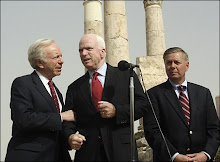
Senator John McCain with the Dalai Lama on Friday at a private residence in Aspen, Colo. The Dalai Lama was in Aspen for a symposium on Tibetan culture
Editor's Comment- I guess he tried to channel his inner-Ghandi by meeing with the Dalai Lama because, unlike most western people, he knew that the honored man of peace wouldn't slap the living daylights out of him. This guy is scary. Trying to wage war while taking photo ops with a well known pacifist. Does he really think he's fooling anybody?
By ELISABETH BUMILLER
Published: July 26, 2008
WASHINGTON — President Bush and Senator John McCain have long been in agreement on major elements of American foreign policy, particularly in their approach to the “axis of evil” countries of Iran and North Korea, and their commitment to staying the course in Iraq.
But now the administration’s agreement to consider a “time horizon” for troop withdrawals from Iraq has moved it, at least in the public perception, in the direction of the policies of Senator Barack Obama. That has thrown Mr. McCain on the political defensive in his opposition to a timed withdrawal, Republicans in the party’s foreign party establishment say.
On Friday Mr. McCain went so far as to say that the idea of a 16-month withdrawal, which Mr. Obama supports, was “a pretty good timetable,” although he included the caveat that it had to be based on conditions on the ground.
Republicans also say the administration’s decision to authorize high-level talks with Iran and North Korea has undercut Mr. McCain’s skepticism about engagement with those countries, leaving the perception that he is more conservative than Mr. Bush on the issue.
Essentially, as the administration has taken a more pragmatic approach to foreign policy, the decision of Mr. McCain to adhere to his more hawkish positions illustrates the continuing influence of neoconservatives on his thinking even as they are losing clout within the administration.
Whether the perception of Mr. McCain as being at odds with the administration is politically advantageous for him is a matter of debate among his supporters, but many of his more conservative advisers do not think it is a bad thing.
“There’s no doubt, particularly as Bush has adopted policies in the direction of Obama, that that gives Obama bragging rights,” said John R. Bolton, the Bush administration’s former ambassador to the United Nations, who has sharply criticized the administration’s talks with Iran and North Korea. “But if you believe as I do that this administration is in the midst of an intellectual collapse, it doesn’t hurt McCain. Occasionally in politics it helps to be right.”
But other Republicans — the so-called foreign policy pragmatists, many of whom have come to view the Iraq war as a mistake — say the administration’s policy shifts highlight the more confrontational nature of Mr. McCain’s foreign policy, particularly in his approach toward Russia and his embrace on Friday of the Dalai Lama, whom the Chinese regard as the fomenter of a rebellion in Tibet. They say the meeting will only antagonize China before the Summer Olympics, and at a moment when the United States is seeking its cooperation on economic issues and negotiations with North Korea.
The divisions within the Republican foreign policy establishment continue at a time when Mr. Obama is trying to establish his own international credentials. Republicans worry that he is seizing the chance, helped with the boost from Mr. Bush, to command the American foreign policy stage.
“Bush and Obama seem to be setting the foreign policy agenda, and McCain seems to be reacting,” said Kenneth M. Duberstein, a chief of staff to President Ronald Reagan.
The McCain campaign disputes the idea that Mr. McCain has been left out on his own by the president.
“Does he feel he had the rug pulled out from under him by Bush?” said Randy Scheunemann, Mr. McCain’s chief foreign policy aide. “Absolutely not. John McCain has always said that he wanted the troops to come home. But he is opposed to an artificial date-driven timetable that ignores conditions on the ground and the advice of military commanders.”
In fact, Mr. Bush’s decision to accept a “general time horizon” for withdrawal from Iraq is still a long way from Mr. Obama’s proposal for a phased pullout, as the administration has not set any timeline.
Mr. McCain has on several recent occasions envisioned a date by when most American troops in Iraq would leave, although he has refused to call it a timetable. In a speech in Ohio in May, he declared that most American troops would be home by 2013. On Monday, in remarks at the side of the first President George Bush in Kennebunkport, Me., Mr. McCain embraced, if only in passing, the possibility of withdrawing most American troops by the end of 2010.
On Friday on CNN, under questioning by Wolf Blitzer, he called Mr. Obama’s 16-month proposal “a pretty good timetable.” But the McCain campaign declined to elaborate Friday night on whether this represented a change in his views.
Mr. McCain’s advisers also say that he is not opposed to talks with Iran and North Korea, and that he supported the administration’s decision to send the under secretary of state, William J. Burns, to Geneva last week for talks with Iran and European officials about Iran’s nuclear program. But Mr. McCain is against any president-to-president negotiations without preconditions, which Mr. Obama supports. (Mr. Obama’s advisers now say such talks would occur only if Mr. Obama deemed them potentially fruitful.)
Mr. McCain’s campaign continues to be a microcosm of the ongoing Republican foreign policy battles between the pragmatists and the neoconservatives like Mr. Bolton, and it is still not clear where the balance of power lies within Mr. McCain’s inner circle. So far, however, the divide between the two within the campaign does not appear as deep as it did within the Bush White House, and advisers say Mr. McCain has been able to chose when there is a policy difference.
Mr. McCain’s advisers were divided, for example, over a speech he gave on nuclear security policy in Denver in May. Two Republican pragmatists who advise Mr. McCain, the former secretaries of state Henry A. Kissinger and George P. Shultz, supported a call in the speech for a nuclear-free world, an idea they endorse as part of a “Gang of Four” of national security statesmen. But other McCain advisers, including John F. Lehman, a former Navy secretary, and Fred C. Ikle, a defense official in the Reagan administration, were opposed to the idea because, in their view, nuclear weapons act as a deterrent against an attack on the United States and its allies. In the end, Mr. Lehman said, Mr. McCain made the call in favor of a nuclear-free world.
“He wanted to do it,” Mr. Lehman said. “That position is McCain’s position. It’s not a cabal of Kissingerites or a cabal of neo-cons.”
But some of Mr. McCain’s pragmatist advisers remain uneasy that conservatives close to Mr. McCain — among them Mr. Scheunemann and Robert Kagan, a scholar at the Carnegie Endowment for International Peace — will help him mold a more bellicose message than they would like on Iran and its threat to Israel, particularly at a time when there is widespread speculation in the Israeli news media that Israeli may bomb Iran’s nuclear facilities.
Others who were once uneasy about the influence of conservatives on Mr. McCain say that their worries have not been realized, even as Mr. McCain has taken conservative positions.
“What I’ve seen in the campaign so far to me demonstrates that McCain is his own man, and he’s not being managed,” said Lawrence S. Eagleburger, a secretary of state under the first President Bush.